
NOTES / SYNTHESIS IN PROGRESS
Thinking,
in its working form.
Real handwritten pages, with the marks, diagrams and developing thoughts left intact.
These pages show one stage: collecting and synthesizing information. They are busy, sometimes messy working notes—not an organizer, a finished index, or a model of neatness. The captions explain what happens on the page; the broader practice of indexing and review is explained separately in the learning guide.
They are examples of synthesis, rather than a demonstration of the whole system, and are not exact specifications for the current product layouts.
01 / PHILOSOPHY & CLOSE READING
Give a dense argument
a visible structure.
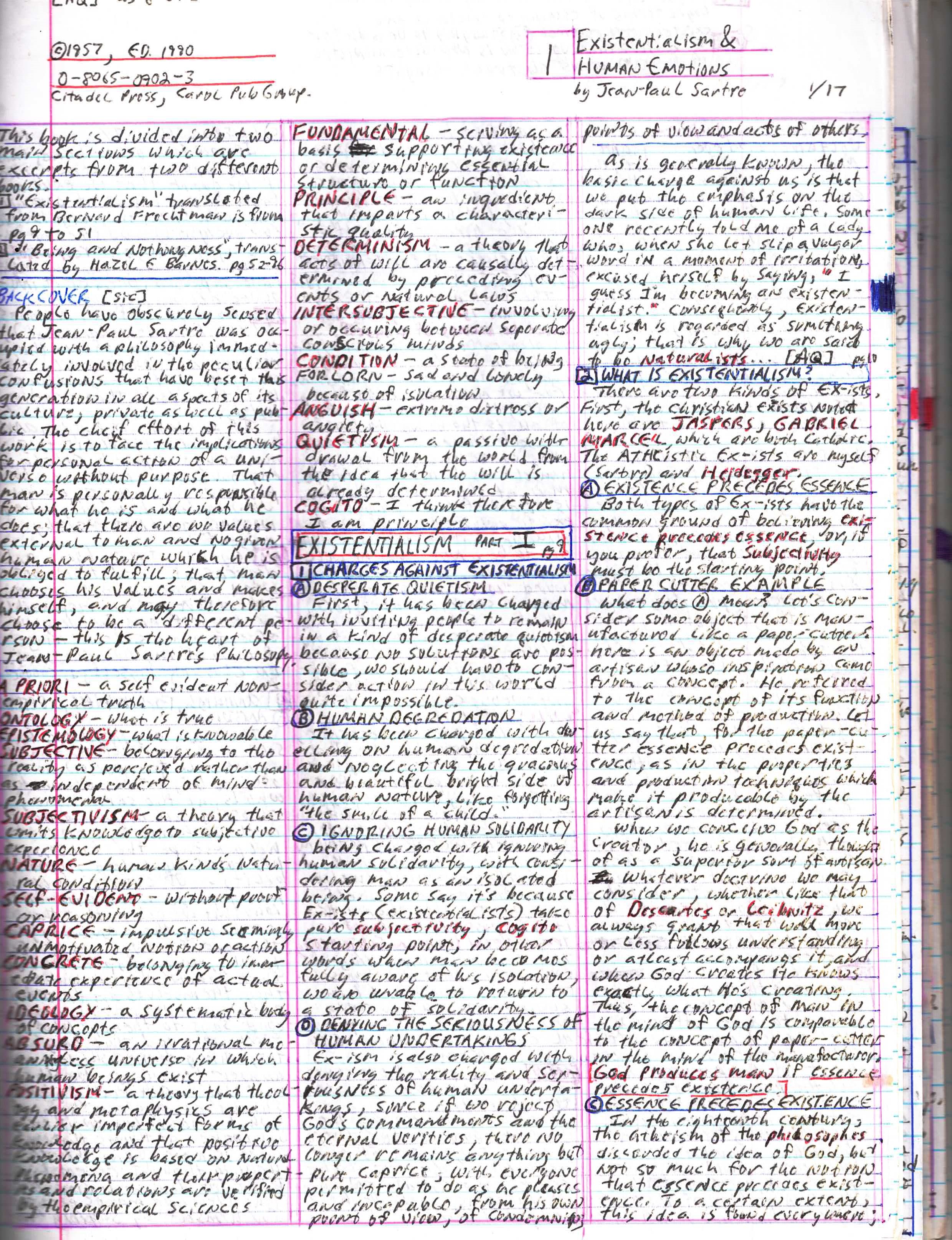
This original photograph records notes on Jean-Paul Sartre’s Existentialism and Human Emotions. Three columns hold source details, vocabulary and an unfolding discussion on the same sheet.
- Page landmarks: the boxed “EXISTENTIALISM / PART II” heading and blue subdivisions mark different levels of the argument.
- Distillation: compact explanations sit alongside red vocabulary terms, keeping the concepts close to their context.
- Source awareness: publication details and page references provide routes back to the text.
- Later retrieval: the sheet-number box and recognizable headings help identify the relevant page and passage when returning to a subject.
The three-column arrangement keeps related material in view. It remains a personal reading record, with its own emphasis and interpretation.
Explore the visual conventions →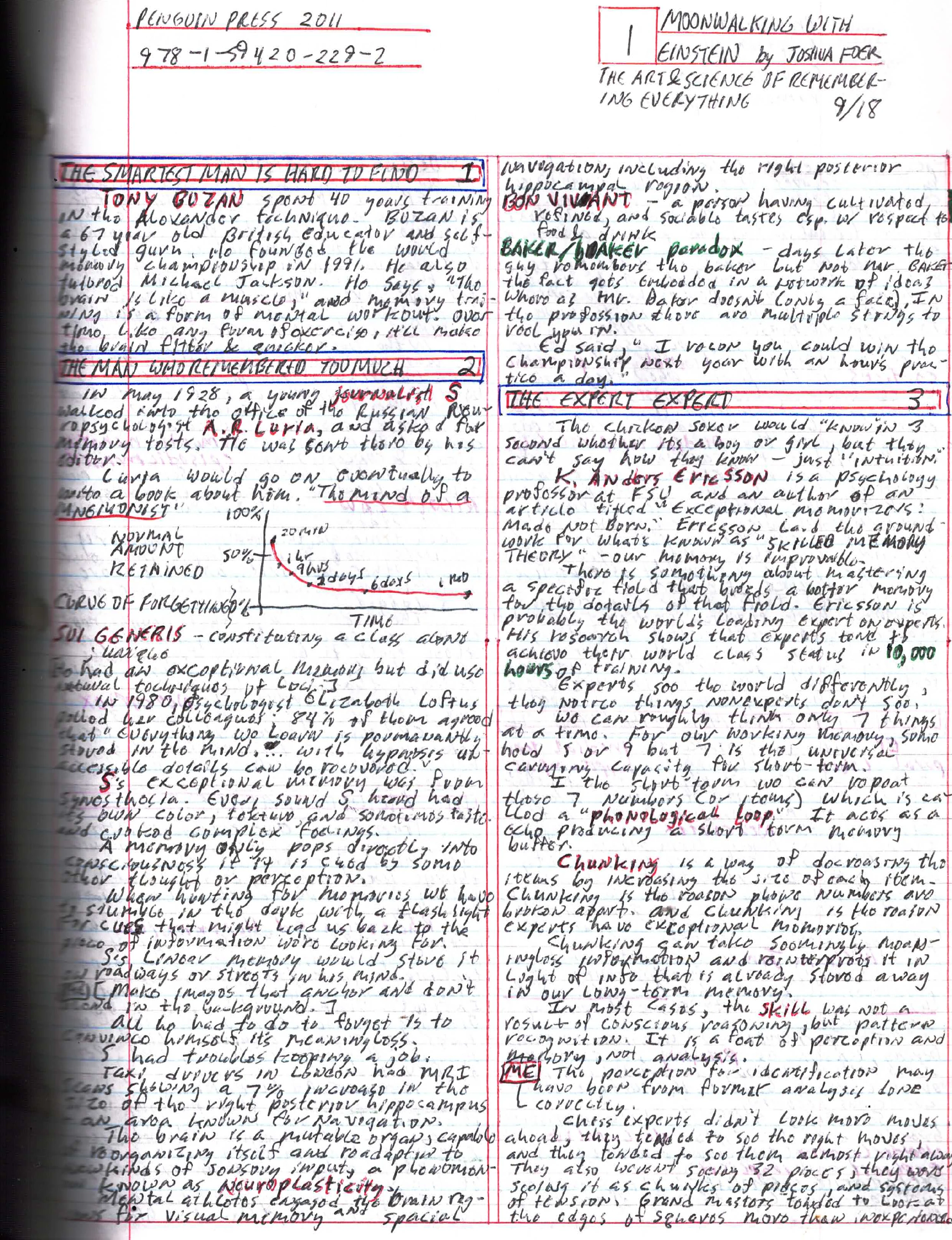
02 / READING & REFLECTION
Keep the source.
Mark your response.
Notes on Joshua Foer’s Moonwalking with Einstein bring chapter summaries, named people and a small graph together on a single sheet.
- Page landmarks: boxed chapter headings divide a dense page into recognizable sections.
- Distillation: compact passages and a forgetting-curve sketch preserve different kinds of information without requiring separate pages.
- Personal thinking: the red boxed ME and attached line distinguish a response from the surrounding reading notes.
- Later retrieval: the book title, publication information and sheet number provide a starting point for identifying the page again.
The practical value is in keeping the source’s ideas and your own thinking distinguishable when you return to the page.
From reading to notes →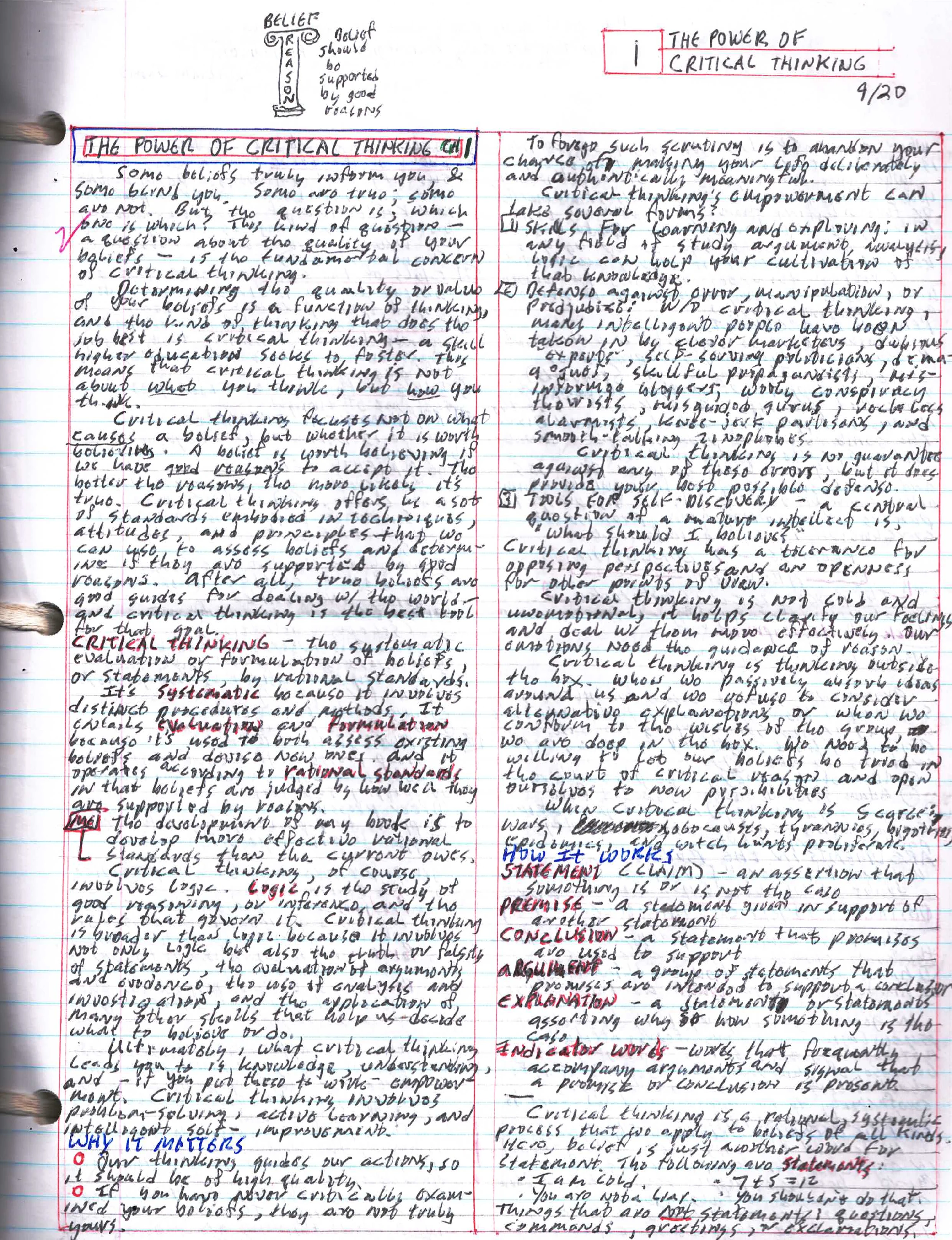
03 / CONCEPTS & DEFINITIONS
Let the hierarchy
do the navigating.
The chapter heading gives the page a clear subject. Blue capital headings—“HOW IT WORKS” and “WHY IT MATTERS”—divide the discussion without large blocks of empty space.
- Page landmarks: indentation marks paragraph beginnings within continuous writing.
- Distillation: definitions of statement, premise, conclusion, argument and explanation appear together for comparison.
- Visual retrieval: red terms stand out against the body text, making the definition you need easier to locate.
- Developing thought: a marked personal comment records a response to the material rather than blending it into the source account.
On a later reading, you can follow the structure from chapter to section to term before committing to reading every line.
Read the notation key →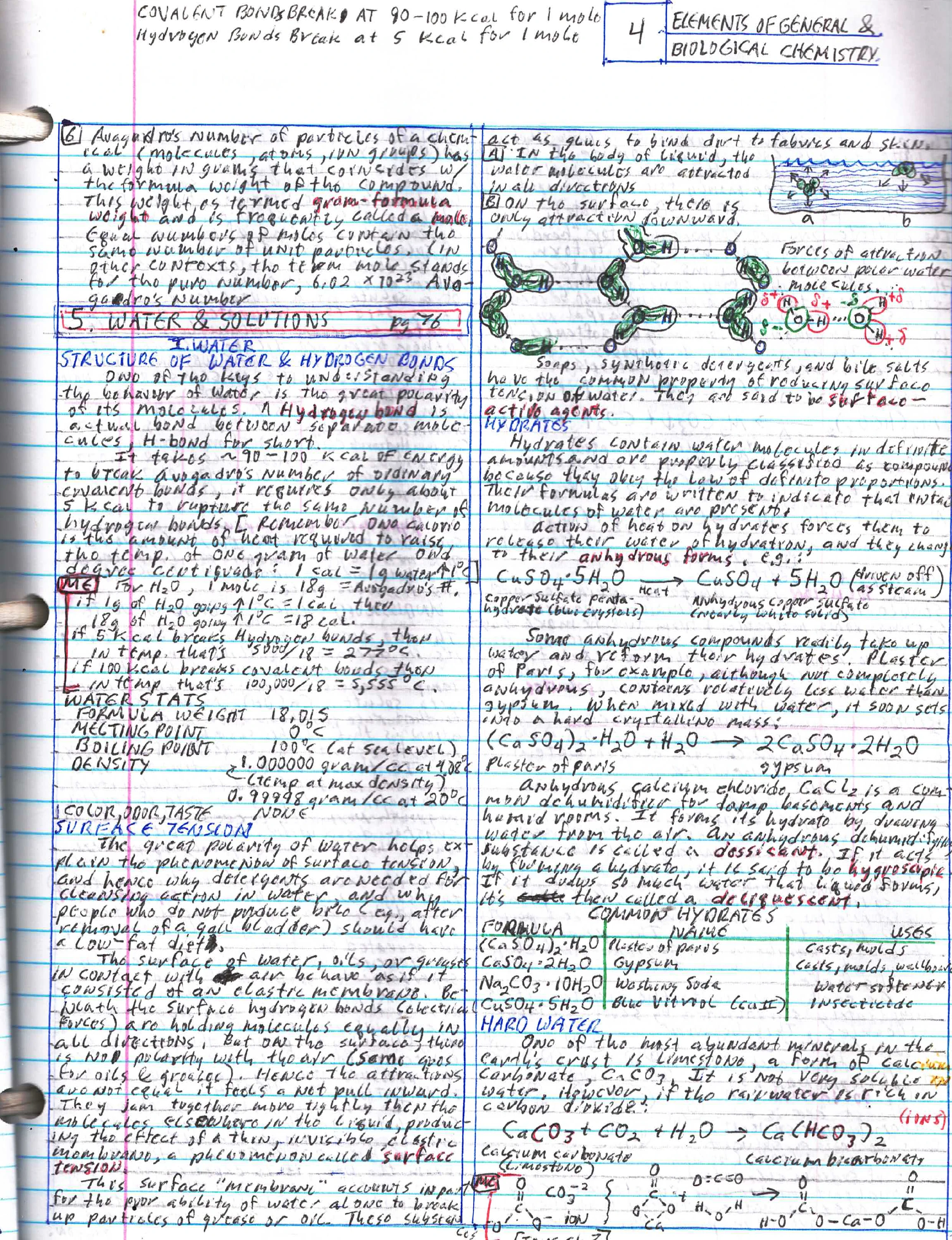
04 / EXPLANATIONS, EQUATIONS & DIAGRAMS
Keep related forms
of information together.
The chemistry page combines notes about water and solutions with molecular sketches, chemical equations and a small table of common hydrates.
- Page landmarks: a boxed chapter title and blue subject headings divide the material.
- Distillation: a diagram shows a relationship that would take several lines to describe; a table aligns formulas, names and uses.
- Flexible space: drawings and equations take the room they need, spanning several ruled lines.
- Later retrieval: the heading and distinctive visual form help distinguish the table or diagram from surrounding paragraphs.
Compression works when it preserves meaning. This page demonstrates why the rules are guides rather than limits on the height of your writing.
Adapt the method to the material →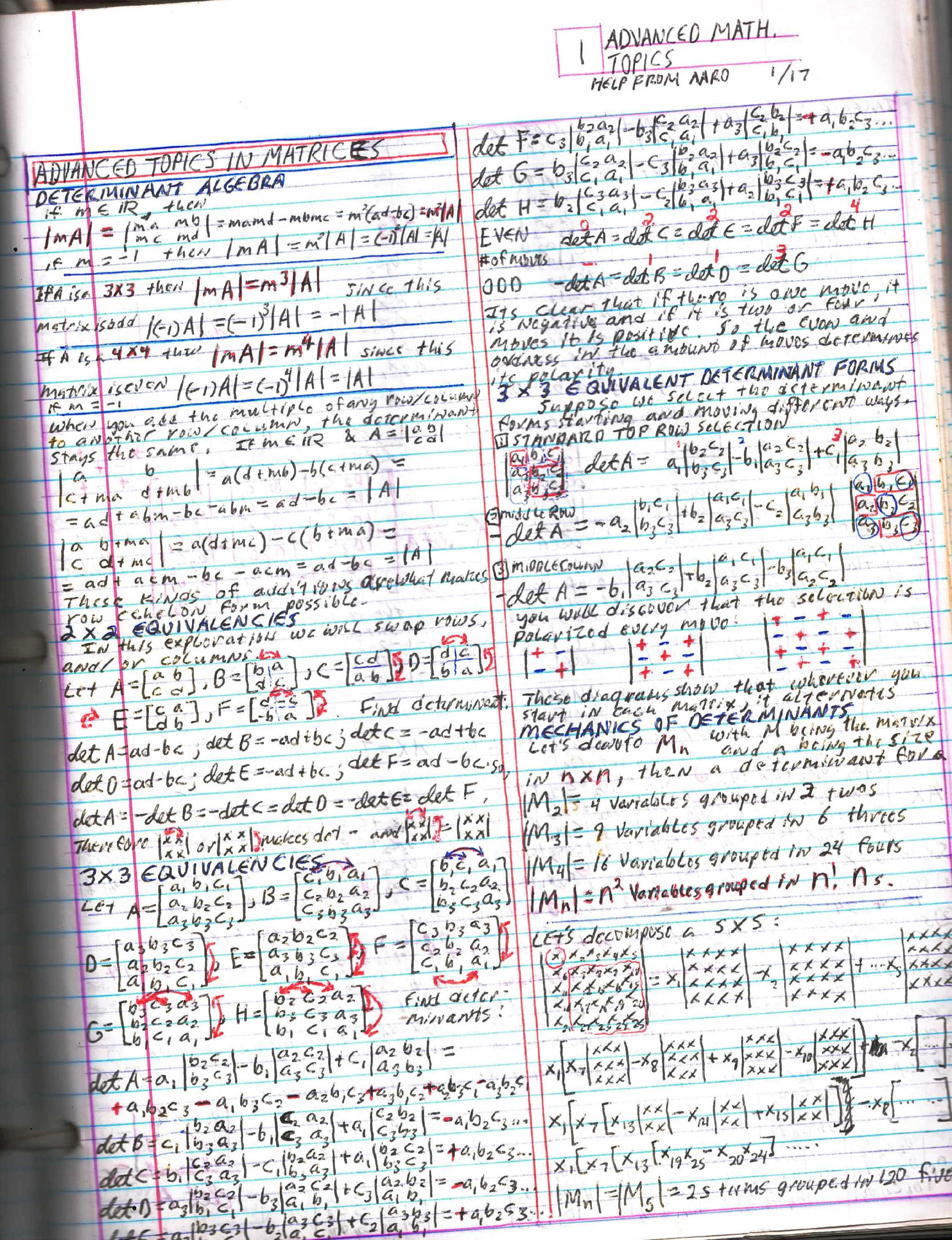
05 / WORKED RELATIONSHIPS
Preserve the steps,
not only the answer.
The mathematics page develops determinant relationships through matrices, equivalent forms, sign patterns and annotated transformations.
- Page landmarks: blue headings group related operations; equations run through the two columns.
- Visual explanation: arrows and colored marks point to the parts of a matrix involved in a transformation.
- Working room: tall expressions use multiple lines, keeping their spatial relationships visible.
- Long-term use: the sequence provides something to reconstruct and check later, instead of an isolated result without its route.
For your own research notes, add source references and index entries that lead directly to the procedure or question you want to revisit.
Make your notes findable →Bring the method to your own subject.
Start with a useful question. Select the material, express what you understand, label your own response, and make a reference you can retrieve. The same principles can support philosophy, technical reading, project research and other subjects without imposing a single page style.